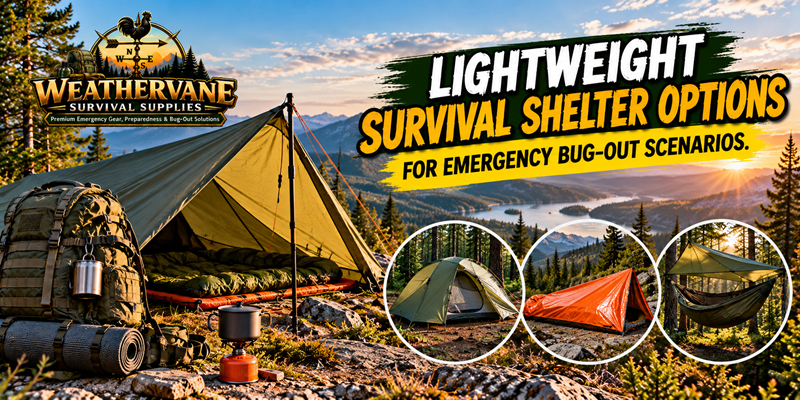
Lightweight Survival Shelter Options for Emergency Bug-Out Scenarios – When sudden disasters force an evacuation, finding reliable protection against extreme weather is an immediate priority. Exposure to rain, wind, and freezing temperatures poses a severe risk of hypothermia or heat exhaustion within hours. During emergency bug-out scenarios, carrying a heavy or bulky shelter is impractical because it drains physical stamina.
Lightweight Survival Shelter Options for Emergency Bug-Out Scenarios
Understanding how to select and deploy lightweight survival shelter options ensures you remain protected without compromising your mobility. Effective emergency shelters must balance portability, ease of setup, and weather resistance to keep you safe when resources are scarce.
The Critical Importance of Shelter in Emergencies
In survival situations, shelter ranks among the highest priorities alongside clean water and breathable air. Human physiology is vulnerable to environmental changes. Without thermal protection, wind chill and moisture can rapidly lower core body temperatures, impairing judgment and physical function.
A lightweight emergency shelter serves as a barrier against adverse weather elements. It helps maintain thermal equilibrium, reduces psychological stress, and provides a secure base camp while you evaluate your evacuation route or wait for rescue operations.
Essential Types of Lightweight Survival Shelters
Various emergency shelter options offer distinct advantages depending on your environment, climate, and packing capacity. Here are the most reliable choices for a bug-out bag:
1. Emergency Survival Tarps
Tarps represent one of the most versatile and lightweight shelter solutions available. Constructed from durable, tear-resistant materials like silnylon or polyethylene, a tarp can be pitched in multiple configurations using paracord and natural surroundings.
-
Advantages: Exceptionally lightweight, highly compact, and adaptable to various terrains (such as lean-tos, A-frames, or plow points).
-
Considerations: Requires basic knot-tying knowledge and anchor points like trees or trekking poles to secure properly.
2. Tube Tents
A tube tent consists of a continuous plastic or lightweight fabric cylinder that you string up between two fixed points using a support rope.
-
Advantages: Inexpensive, very lightweight, and sets up in under two minutes. Many versions feature high-visibility orange material to signal rescue teams.
-
Considerations: Offers limited structural durability in heavy winds and provides minimal floor protection unless combined with a ground sheet.
3. Emergency Bivy Sacks
A bivy sack is a waterproof, breathable, or reflective sleeve designed to enclose an individual sleeping bag or body directly. Modern emergency bivy sacks often use metallized mylar to reflect body heat. How to Choose the Right Tactical Backpack for Long-Distance Evacuation
-
Advantages: Requires zero assembly time, takes up virtually no space in a backpack, and provides maximum thermal retention in freezing conditions.
-
Considerations: Offers restricted interior space, which can feel confining for prolonged stays during multi-day emergencies.
4. Lightweight Poncho Tarps
Combining two essential gear items into one, a poncho tarp functions as a wearable rain poncho during travel and transforms into a makeshift shelter when staked down.
-
Advantages: Saves critical pack space and weight by serving a dual purpose.
-
Considerations: Typically offers smaller coverage area compared to standalone heavy-duty tarps.
Key Factors to Evaluate When Choosing Your Shelter
Selecting the right shelter for your bug-out bag requires assessing several functional criteria to ensure it performs under pressure.
-
Weight and Packability: Your shelter should weigh under two pounds and compress into a compact size that leaves ample room for water, food, and medical supplies.
-
Material Durability: Look for waterproof ratings (measured in millimeters of hydrostatic head) and ripstop weaving that prevents small punctures from tearing into large structural failures.
-
Ease of Deployment: In stressful or low-light situations, your shelter should deploy rapidly without requiring complex assembly or specialized tools.
Best Practices for Pitching a Field Shelter
Even the highest-quality shelter will fail if installed incorrectly. Follow these fundamental guidelines when setting up your emergency bivouac:
-
Select a Safe Location: Avoid dry riverbeds prone to flash floods, low-lying valleys where cold air pools, and dead trees or loose branches that could fall during high winds.
-
Insulate from the Ground: Always use a ground mat, pine boughs, or a mylar sheet underneath your sleeping area to prevent body heat from conducting into cold earth.
-
Secure Your Guy Lines: Ensure all tension lines and stakes are anchored firmly to withstand sudden gusts of wind or heavy downpours.
Final Thoughts
A lightweight survival shelter is an indispensable component of any preparedness kit. By choosing reliable equipment such as a compact tarp, bivy sack, or tube tent, you guarantee yourself a mobile safe haven against harsh environmental conditions. Evaluate your regional climate, select a versatile shelter that matches your physical capabilities, and practice setting it up before an emergency forces your hand.