Comparing Gravity Filters, UV Purifiers and Chemical Water Treatment Tablets – Selecting the right water purification method is a fundamental decision for outdoor survivalists, disaster response teams, and emergency planners. In field environments, accessing clean drinking water is vital for physical health and cognitive endurance. However, untreated wilderness water often contains harmful bacteria, parasites, organic silt, and microscopic viruses that can lead to severe illness.
Comparing Gravity Filters, UV Purifiers and Chemical Water Treatment Tablets
To address these hazards, three primary water treatment technologies dominate the outdoor and emergency preparedness industries: gravity filters, ultraviolet (UV) purifiers, and chemical water treatment tablets. Evaluating these systems side-by-side helps you choose the best option for your specific field scenarios.
Understanding the Importance of Method Matching
No single water purification technology excels in every environmental scenario. A system that works perfectly in a backcountry base camp may prove impractical during a rapid urban evacuation.
When evaluating purification systems, consider crucial performance factors such as treatment speed, weight, electrical dependency, capacity, and effectiveness against various biological pathogens. Matching your purification technology to your target environment ensures long-term hydration security.
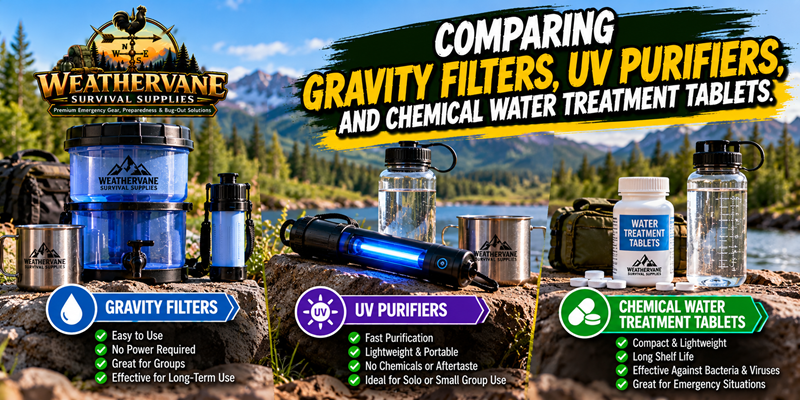
Option 1: Gravity Water Filters
Gravity filters use natural gravitational pull to draw water from an upper reservoir through a fine micro-membrane filter into a lower clean water container.
-
Primary Advantages: Gravity filters operate completely passively, requiring zero manual pumping or electrical power. They process large volumes of water efficiently, making them the superior choice for group survival camps and family preparedness. Furthermore, physical hollow-fiber membranes effectively trap sediment, silt, protozoa, and bacteria.
-
Primary Limitations: Gravity systems require a fixed overhead anchor point, such as a tree branch, to hang the upper reservoir. They are slightly bulkier in a backpack and generally do not eliminate microscopic viruses unless paired with specialized chemical purifiers.
Option 2: Ultraviolet (UV) Water Purifiers
Ultraviolet purifiers use handheld electronic lamps to emit high-intensity UV-C light rays into a water bottle. This radiation destroys the DNA of biological pathogens within seconds, preventing them from reproducing.
-
Primary Advantages: UV radiation provides broad-spectrum protection, destroying bacteria, protozoa, and viruses almost instantaneously without changing the taste or temperature of the water. The treatment process is fast and requires minimal physical effort.
-
Primary Limitations: UV light cannot penetrate cloudy, turbid, or muddy water, which means water must be pre-filtered through a cloth or sediment screen first. Additionally, UV purifiers rely entirely on battery power and contain fragile glass elements that can break if dropped on rough terrain.
Option 3: Chemical Water Treatment Tablets
Chemical purification relies on water-soluble tablets—typically utilizing chlorine dioxide or sodium dichloroisocyanurate (NaDCC)—to disinfect water by destroying cell walls of harmful microorganisms. How to Rainwater Harvest Safely for Emergency Backup Water Supplies
-
Primary Advantages: Chemical tablets represent the lightest and most compact water purification solution available. They take up virtually no space in an emergency kit, feature long shelf lives, and function independently of electrical power or mechanical pumps. Chlorine dioxide tablets effectively neutralize bacteria, viruses, and cryptosporidium.
-
Primary Limitations: Chemical disinfection requires patience; depending on water temperature and clarity, treatment times range from thirty minutes to four hours. Some chemical treatments leave a slight aftertaste, and they do not remove physical dirt, sand, or suspended debris from the water.
Comparative Analysis Summary
To help you compare these three systems quickly, evaluate their core features across key operational categories:
-
Volume and Group Capacity: Gravity filters win clearly for high-volume, multi-person base camps due to their hands-free operational style.
-
Treatment Speed: UV purifiers deliver the fastest results for single water bottles, provided the source water is clear.
-
Portability and Emergency Backup: Chemical tablets are unbeatable for ultralight bug-out bags, serving as a foolproof mechanical-failure backup.
-
Viral Protection: UV light and chemical tablets effectively destroy viruses, whereas standard mechanical gravity filters focus primarily on bacteria and protozoa.
Final Thoughts
Understanding the strengths and limitations of gravity filters, UV purifiers, and chemical tablets allows you to build a resilient water treatment strategy. While gravity filters offer effortless volume for home and camp setups, UV devices excel at rapid bottle treatment, and chemical tablets provide a lightweight emergency backup. Combine these methodologies to ensure you always have access to clean, safe drinking water, regardless of the challenges you face in the field.