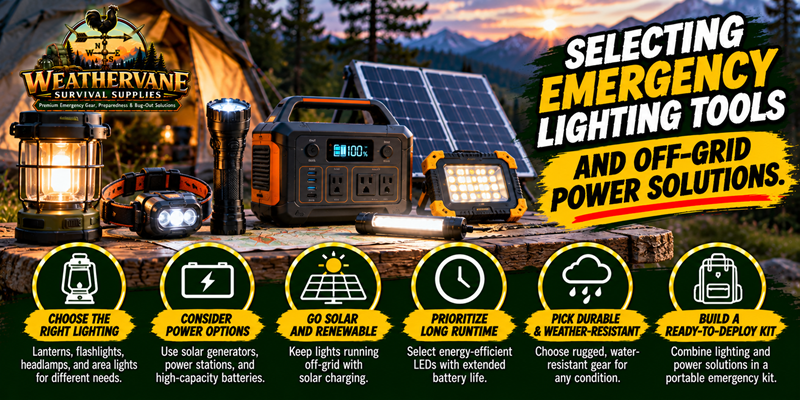
Selecting Emergency Lighting Tools and Off-Grid Power Solutions – Navigating through sudden power outages requires reliable illumination and independent energy reserves. When natural disasters, grid failure, or severe storms disrupt local utility lines, standard home lighting systems fail immediately. Lacking adequate visibility increases household safety risks, complicates emergency navigation, and hinders routine task performance during blackouts.
Selecting Emergency Lighting Tools and Off-Grid Power Solutions
Selecting specialized emergency lighting tools and off-grid power solutions provides a structured defense against unexpected darkness. Understanding the functional differences between tactical flashlights, area lanterns, headlamps, and portable energy storage units enables homeowners to build a balanced, resilient emergency lighting setup.
The Importance of Layered Emergency Lighting
Relying on a single lighting source during a prolonged crisis creates operational vulnerabilities. A comprehensive emergency readiness plan incorporates a layered lighting strategy, matching specific illumination tools to distinct tasks and spatial needs.
A balanced lighting kit combines directional focus for movement, ambient illumination for living spaces, and hands-free operation for manual repair tasks. Pairing these lighting devices with robust off-grid charging options guarantees continuous functionality over extended power loss events.
Key Categories of Emergency Lighting Tools
Selecting primary lighting hardware requires evaluating beam distance, runtime efficiency, durability, and hands-free usability.
1. High-Output Tactical Flashlights
Tactical flashlights offer intense, focused beams designed for long-distance identification and perimeter scanning.
-
Key Features: Constructed from anodized aircraft-grade aluminum, these flashlights resist severe physical impacts and water immersion.
-
Optimal Usage: Ideal for outdoor search operations, property checks, and signaling across long distances during nocturnal emergencies.
2. Hands-Free LED Headlamps
Headlamps represent the most versatile personal lighting tool for close-range tasks and movement through dark environments.
-
Key Features: Positioned directly on the user’s forehead, headlamps cast light wherever the head turns while keeping both hands completely free.
-
Optimal Usage: Essential for performing mechanical gear repairs, administering first aid, and carrying supplies through dark indoor passages.
3. Ambient Area Lanterns
Unlike directional flashlights, area lanterns emit diffused 360-degree illumination to light up entire rooms or outdoor campsites.
-
Key Features: Modern LED lanterns feature adjustable brightness modes, warm light spectrum options, and frosted diffusers that prevent eye strain.
-
Optimal Usage: Positioned on central tables or suspended from ceilings to create comfortable, usable light in living areas during family shelter-in-place scenarios.
Selecting Off-Grid Power Sources for Lighting Gear
Illumination tools require steady energy replenishment. To maintain operational readiness when electrical outlets are dead, combine multiple LINK JOIN QQ off-grid power technologies.
1. Dual-Fuel and Rechargeable Battery Systems
Modern survival lights often feature dual-fuel capability, accepting both internal rechargeable lithium-ion cells and disposable alkaline or CR123A batteries.
-
Versatility: Internal lithium batteries deliver high lumens and easy USB charging, while primary disposable batteries serve as dependable backups when power grids stay down for weeks.
2. Foldable Solar Charging Arrays
Compact, weather-resistant solar panels convert natural sunlight directly into USB charging power.
-
Deployment: Placing a 14-watt to 28-watt folding solar charger in direct sunlight recharges headlamps, flashlights, and small power banks within hours during daylight.
3. High-Capacity Portable Power Stations
Portable lithium power stations act as central energy hubs for off-grid lighting setups.
-
Capacity: Storage units ranging from 250Wh to 1,000Wh can recharge individual tactical flashlights and headlamps dozens of times while running low-draw LED desk lamps continuously for days.
Crucial Selection and Maintenance Protocols
To ensure emergency lighting tools function reliably when crisis strikes, follow disciplined inspection and storage routines:
-
Verify IPX Water Resistance Ratings: Choose lighting gear rated at IPX4 or higher to ensure hardware survives heavy rainfall, flooding, and harsh outdoor weather.
-
Prevent Battery Corrosion: Never store disposable alkaline batteries inside flashlights for long periods. Alkaline cells leach corrosive chemicals over time, destroying internal contacts.
-
Establish Scheduled Battery Maintenance: Recharge all lithium-ion flashlights and portable power stations every three to six months to maintain cell health and prevent deep discharge degradation.
Final Thoughts
Selecting effective emergency lighting tools and off-grid power solutions is a fundamental pillar of residential disaster readiness. By combining high-output tactical flashlights, hands-free headlamps, and ambient room lanterns with reliable solar charging devices, you eliminate the hazards of total darkness. Invest in durable, energy-efficient lighting solutions today to ensure your household remains safe, clear-headed, and fully functional whenever the electrical grid fails.