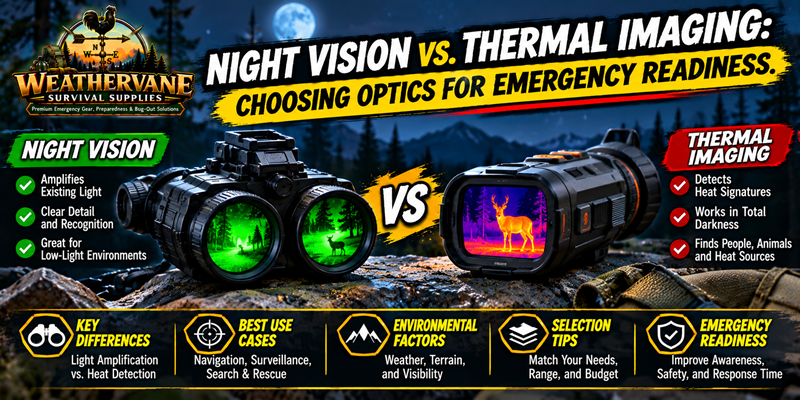
Night Vision vs. Thermal Imaging: Choosing Optics for Emergency Readiness – Traversing pitch-black or low-visibility environments presents a major tactical obstacle during sudden blackout evacuations. Whether monitoring property perimeters during power grid failures or moving through unlit wilderness, maintaining clear vision remains critical. Modern tactical optical devices empower individuals to observe surroundings in dark environments, supplying key spatial awareness when electric lights are unavailable.
Night Vision vs. Thermal Imaging: Choosing Optics for Emergency Readiness
Selecting appropriate low-light optics requires evaluating two primary technologies: Night Vision (NV) devices and Thermal Imaging units. Analyzing how these two unique optical mechanisms function, alongside their individual operational benefits and constraints, enables you to pick the ideal gear for your survival setup.
Mechanics Behind Night Vision Devices
Night vision hardware functions through an electronic process known as image intensification. Instead of generating visual feeds from thermal readings, night vision gathers tiny amounts of natural light—such as ambient moonlight, starlight, or infrared (IR) illuminator beams—and magnifies those light waves thousands of times.
Light rays enter through an objective glass element and hit a photosensitive cathode plate, which converts light particles into stream electrons. These accelerated electrons travel across a microchannel structure, striking a internal phosphor layer that translates the electrical signals back into a visible green or white phosphor image.
-
Main Strengths: Night vision delivers realistic depth perception, precise spatial clarity, and sharp visual recognition. It allows users to read written signs, identify individual human faces, and navigate physical terrain smoothly on foot or in vehicles.
-
Main Limitations: Intensifier systems demand at least minimal external light rays to function. Inside sealed windowless structures or subterranean spaces, they depend completely on auxiliary infrared emitters. Furthermore, night vision cannot peer through thick smoke, dense fog, or biological camouflage.
Mechanics Behind Thermal Imaging Units
In contrast to image intensification devices, thermal imaging does not rely on environmental light particles. Instead, thermal sensors measure micro-changes in infrared radiation (heat energy) given off by living bodies, mechanical engines, and surrounding objects.
Thermal micro-bolometers convert these heat variations into a contrast map, displaying warmer targets in bright colors (white, red, or yellow) against cooler background elements (dark blue or charcoal).
-
Main Strengths: Thermal sensors function flawlessly in complete darkness without requiring auxiliary infrared flashlights. They instantly expose hidden thermal profiles—such as human bodies, wildlife, or warm machinery—even through heavy brush, thick smog, and total obscurity.
-
Main Limitations: Thermal devices do not record visual surface details. Consequently, you cannot read printed labels, recognize specific facial features, or look through glass barriers, because glass reflects infrared heat signatures back at the sensor.
Direct Operational Comparison for Emergency Readiness
Comparing night vision and thermal sensors side-by-side clarifies which optical tool suits your emergency plans. Personal Security Fundamentals During Urban Evacuation Scenarios
1. Target Detection vs. Precise Identification
-
Target Detection (Thermal Advantage): Thermal sensors excel at spotting hidden targets across vast outdoor distances. A human body concealed behind dense forest brush stands out clearly on a thermal display screen.
-
Target Identification (Night Vision Advantage): Night vision provides superior capability for detailed identification. It allows operators to recognize specific faces, read gear markings, and verify object details that thermal displays cannot render.
2. Physical Movement and Terrain Navigation
Traveling dynamically across rugged terrain while wearing head-mounted devices demands natural spatial depth and real-time refresh speeds. Night vision systems offer smooth movement capability with minimal spatial disorientation. Conversely, walking using a thermal monocular can be challenging because rocks and level ground often share identical temperatures, appearing flat on screen displays.
3. Power Consumption and Field Reliability
Analog night vision tubes draw minimal electrical current, often operating up to forty continuous hours on one standard AA battery. Digital thermal processors require heavy computing power, which drains battery cells rapidly and necessitates carrying multiple replacement batteries during long field trips.
Hybrid Systems: The Fused Alternative
To maximize operational performance, modern tactical manufacturers produce fused optical units that combine image intensification with thermal sensors into a single display. Hybrid optics overlay glowing thermal signatures directly onto crisp night vision feeds. Although fusion devices offer comprehensive field capabilities, they command significantly higher market prices and add extra weight to head mounts.
Final Thoughts
Selecting between night vision units and thermal imaging sensors depends on your core tactical priorities during a disaster. If your primary objective is foot movement, vehicle navigation, and precise target identification, night vision is the superior choice. If your goal centers on long-range perimeter defense, spotting hidden targets through foliage, and operating in total darkness, thermal imaging offers clear advantages. Integrating both optical technologies into your gear roster ensures complete visual dominance in any low-light situation.