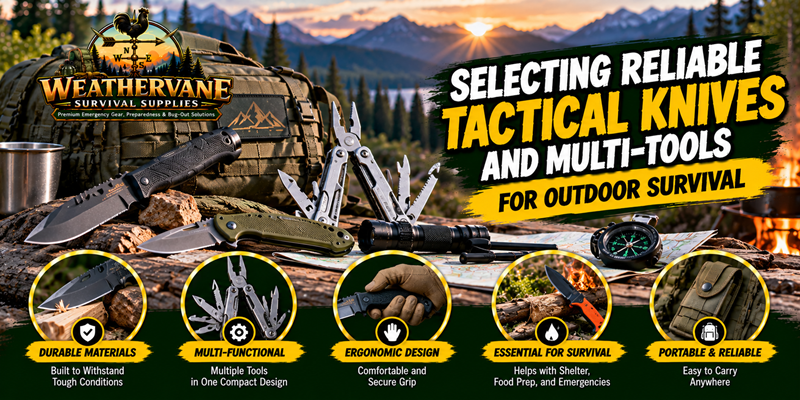
Selecting Reliable Tactical Knives and Multi-Tools for Outdoor Survival – In outdoor survival and emergency wilderness scenarios, a reliable cutting tool is the most fundamental piece of gear you can carry. From processing firewood and crafting emergency shelters to preparing food and constructing improvised tools, a high-performance blade performs countless critical survival tasks. When municipal infrastructure collapses or backcountry travel presents unexpected hazards, your knife serves as your primary physical utility.
Selecting Reliable Tactical Knives and Multi-Tools for Outdoor Survival
Selecting the right combination of tactical knives and multi-tools requires evaluating steel metallurgy, structural design, and field versatility. Understanding the functional differences between heavy-duty fixed blades and precision multi-tools enables you to construct a comprehensive cutting system that will not fail under field conditions.
Fixed Blades vs. Folding Multi-Tools: Understanding the Roles
A complete survival cutting system relies on two complementary tools rather than a single compromise. Fixed blade knives and multi-tools serve distinct operational roles in the field:
-
Heavy-Duty Fixed Blades: Engineered for high-impact tasks that demand structural strength, such as splitting small logs (batoning), carving hard wooden stakes, and performing heavy leverage work.
-
Multi-Tools and Folding Knives: Built for fine precision work, gear repair, wire cutting, and intricate tasks where multiple specialized tool heads are needed.
Combining a rugged full-tang fixed blade with a feature-rich multi-tool ensures you can handle both heavy demolition and delicate maintenance work efficiently.
Critical Selection Criteria for Tactical Survival Knives
To ensure your primary fixed blade knife withstands severe field abuse without snapping or dulling prematurely, evaluate prospective blades against four core structural criteria.
1. Full-Tang Construction
A full-tang design means the steel blade extends continuously through the entire length of the handle in one solid piece. Full-tang construction provides maximum structural integrity, preventing the handle from breaking away from the blade during heavy batoning or prying.
2. Steel Metallurgy: Carbon vs. Stainless Steel
Blade steel composition determines edge retention, toughness, and corrosion resistance.
-
High-Carbon Steel (e.g., 1095 Carbon): Exceptionally tough, easy to sharpen in the field using natural river stones, and retains an edge well. However, it requires routine oiling to prevent rust.
-
Modern Stainless Steel (e.g., CPM-3V, S35VN): Offers superior corrosion resistance against rain and humidity while maintaining high edge sharpness. Modern metallurgy has significantly improved stainless steel toughness.
3. Blade Geometry and Spine Design
A drop-point or clip-point blade profile with a flat ground edge offers optimal versatility for skinning, carving, and piercing. Ensure the spine (top flat edge) features a sharp 90-degree angle. A 90-degree spine allows you to strike ferrocerium fire rods effectively without dulling your primary cutting edge.
Evaluating Multi-Tools for Field Maintenance
While a fixed blade handles heavy physical work, a quality multi-tool acts as a compact, portable toolbox. Selecting a field-ready multi-tool requires focusing on essential components:
-
Heavy-Duty Pliers and Wire Cutters: Heavy pliers allow you to manipulate hot cookware, mend wire fences, and repair broken metal gear fasteners safely.
-
Locking Mechanism: Ensure every individual tool blade locks securely in the open position to prevent accidental folding during use.
-
Saws and Can Openers: Built-in wood saws process small tinder rapidly, while dedicated can openers process canned rations without dulling your primary knife.
In complex technical infrastructure systems and digital resource management, utilizing structured operational frameworks prevents tool degradation and project delays. Applying a structured maintenance framework to your survival gear similarly guarantees that every mechanical tool remains sharp and rust-free when deployed. Essential Personal Protective Equipment for Chemical and Environmental Hazards
Proper Field Care and Sharpening Protocols
Even the highest-grade tactical knife will degrade if subjected to improper maintenance. Establish routine field care protocols to preserve your cutting tools:
-
Keep Blades Clean and Dry: Wipe away sap, moisture, and dirt after every use before sheathing your knife.
-
Apply Protective Lubrication: Apply a thin layer of food-safe mineral oil to carbon steel blades to create a protective barrier against oxidation.
-
Maintain Edge Alignment: Carry a lightweight diamond sharpening rod or ceramic hone in your pack to touch up micro-burrs before the edge becomes completely dull.
Final Thoughts
Selecting reliable tactical knives and multi-tools is a vital investment in your long-term outdoor survival security. By prioritizing full-tang construction, durable steel metallurgy, locking multi-tool mechanisms, and regular maintenance, you ensure your cutting tools perform flawlessly under pressure. Equip yourself with quality cutting gear today to maintain complete operational capability wherever your outdoor journey takes you.